
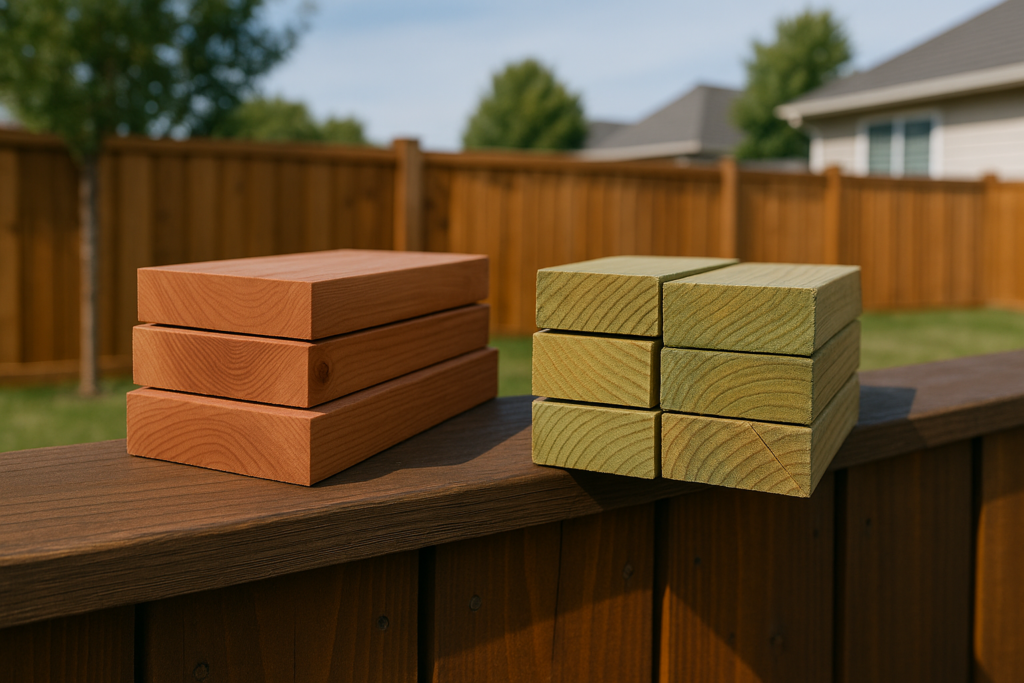
Cedar and pressure-treated pine are the two woods behind the vast majority of residential privacy fences, and the price gap between them usually runs 25% to 50% per linear foot. The right choice for your wooden fence installation in Bucks County depends less on which board looks better at the lumberyard and more on how each species behaves after three winters. Here is how the two materials actually compare on cost, movement, rot resistance and upkeep.
What Actually Separates Cedar From Pressure-Treated Pine
Cedar resists decay because of natural oils and extractives in the heartwood, which make the wood unappetizing to fungi and insects without any chemical help. Pressure-treated pine starts as fast-growing southern yellow pine, then gets preservatives forced into the fibers under pressure inside a cylinder.
Both approaches work, but they fail differently. Cedar weathers slowly and gracefully, graying from the outside in, while treated pine tends to check, twist and split as it dries out over the first two seasons.
The preservatives used today (typically copper azole or alkaline copper quaternary) replaced the old CCA formulas for residential use back in 2003. The EPA’s overview of wood preservative chemicals explains which products are still registered for ground contact.
Real Costs Per Foot
Installed pricing varies with terrain, gate count and whether an old fence has to come out, but the ranges below reflect what most homeowners see for a standard six-foot privacy fence.
- Pressure-treated pine: roughly $28 to $45 per linear foot installed, materials and labor included.
- Western red cedar: roughly $38 to $65 per linear foot, depending on grade and picket thickness.
- Gates: $350 to $900 each, with wider drive gates and steel frames at the top of that range.
- Old fence removal and disposal: commonly $3 to $8 per foot.
For a 200-foot run, that puts treated pine around $5,600 to $9,000 and cedar closer to $7,600 to $13,000. The cedar premium on a mid-sized yard usually lands between $1,500 and $3,000, which is worth weighing against how long you plan to stay in the house.
How Each Wood Holds Up in Weather
Our freeze-thaw cycles are harder on fences than steady cold would be, because water gets absorbed, expands, and works joints loose over and over. Humid July stretches then push moisture back into boards that spent April drying out.
Cedar handles that cycling better because it is dimensionally stable and absorbs less water across the grain. Treated pine absorbs more, which is why a board that was flat on delivery day can cup by the following spring if it was never sealed.
Rot resistance is closer than people assume. Ground-contact treated pine often outlasts cedar in the soil, while cedar wins above grade. The USDA Forest Products Laboratory’s Wood Handbook documents those durability differences by species in detail.
Warping, Checking and the Movement Problem
Most complaints about a new wood fence are not about rot at all. They are about pickets that twisted, split at the nail line or pulled away from the rail during the first dry spell.
Treated lumber arrives wet from the treatment cylinder, sometimes carrying 40% to 60% moisture content, and it shrinks as it releases that water. Kiln-dried-after-treatment (KDAT) stock costs 15% to 25% more but moves far less, and it accepts stain immediately instead of after a six-month wait.
Cedar typically shows up at a lower moisture content and stays put. If you want a fence line that still reads straight from the street in year five, that stability is the strongest argument for paying more upfront.
Looks, Stain and Going Gray
Cedar’s reddish-brown tone and tight grain photograph well and take semi-transparent stain evenly. Left alone, it fades to a soft silver-gray within 12 to 18 months of sun exposure.
Treated pine carries a greenish or brown tint from the preservative and has knottier, more open grain. It can look excellent stained a solid color, which is a common choice when the fence needs to coordinate with trim or shutters.
Decorative styles read differently in each wood too. Cedar is the usual pick for lattice-topped panels and other detail work, since the thinner components hold their shape.
The Hybrid Build Most Contractors Recommend
There is a third option that competitors’ DIY guides rarely mention: use each material where it performs best. Set pressure-treated posts rated for ground contact, then run cedar rails and pickets above grade.
- Posts: 4×4 or 5×5 treated pine stamped UC4A or UC4B for in-ground use.
- Rails and pickets: cedar, for stability, appearance and lighter weight on gates.
- Fasteners: hot-dipped galvanized or stainless ring-shank nails or screws, since the copper in modern treated wood corrodes plain steel.
Posts are the component that kills a fence first, and roughly 80% of fence failures we see start below grade. A leaning wooden fence post is almost always a rot or frost-heave problem, not a panel problem.
Setting Posts So the Fence Outlives the Lumber
In our region, post holes should reach 36 inches or deeper to get below the frost line, with a diameter about three times the post width. Six inches of compacted gravel at the bottom lets water drain instead of pooling against end grain.
Concrete is standard for wood fence posts, though it should be crowned above grade so water sheds away rather than collecting in a bowl. The same principles apply on commercial work, including heavier-duty jobs like warehouse cage and fence installation, where loads and gate traffic are higher.
Maintenance Over 20 Years
Neither wood is maintenance-free, and the gap in upkeep is smaller than the gap in purchase price. Plan on a wash and a fresh coat of stain or sealer every two to three years for either species.
- Cedar, sealed on schedule: commonly 20 to 30 years.
- Cedar, left bare: 15 to 20 years, with surface checking after a decade.
- Treated pine, sealed: 15 to 25 years above grade, longer for the posts.
- Treated pine, never finished: often 10 to 15 years before pickets warp badly enough to replace.
Our notes on timber durability and fence lifespan go further into what moves those numbers, and there are practical ways to cut down on routine wood fence maintenance through design choices alone.
Which Wood Fits Which Homeowner
Choose cedar if you want a stained or natural finish, you are fencing a front or side yard that neighbors see daily, or you intend to stay in the home ten or more years. Choose treated pine if the fence is mostly functional, the budget is firm, or you plan to paint it a solid color anyway.
Long runs change the math quickly. On a property needing 400 feet of privacy fence, the cedar premium can exceed $6,000, which is often where the hybrid build earns its keep.
Get a Quote on Your Cedar or Pressure-Treated Fence
We install both woods across the region, and we will price both options side by side so you can see the real difference on your property. Contact us today for measurements and a written estimate.